Happy Cats at Home: Simple Ways to Keep Your Indoor Cat Entertained

To us, home may feel like a cozy retreat. To an indoor cat, it’s their entire world. The same rooms, the same furniture, the same view—and, unfortunately, the same empty food bowl they’re absolutely certain should have been filled ten minutes ago. While indoor life protects cats from many outdoor dangers, it also means that we are responsible for making their environment interesting, comfortable, and fun. Fortunately, keeping a cat happy at home doesn’t require turning your living room into an elaborate feline amusement park. A few simple changes can give your cat opportunities to climb, scratch, hunt, explore, play, watch, hide, and—of course—nap.

Let Them Hunt for Their Food
Cats are natural hunters, but for many indoor cats, hunting consists of walking into the kitchen and staring intensely at a human until dinner appears.

Make mealtime more interesting by occasionally hiding small portions of treats or dry food around the house. Start with easy hiding places where your cat can see or smell the reward, then gradually make the hunt more challenging. A treat on a cat-tree platform, a few pieces of kibble tucked beside a favorite toy, or tiny "treasure" stations in different rooms can encourage your cat to explore and use its nose and brain.
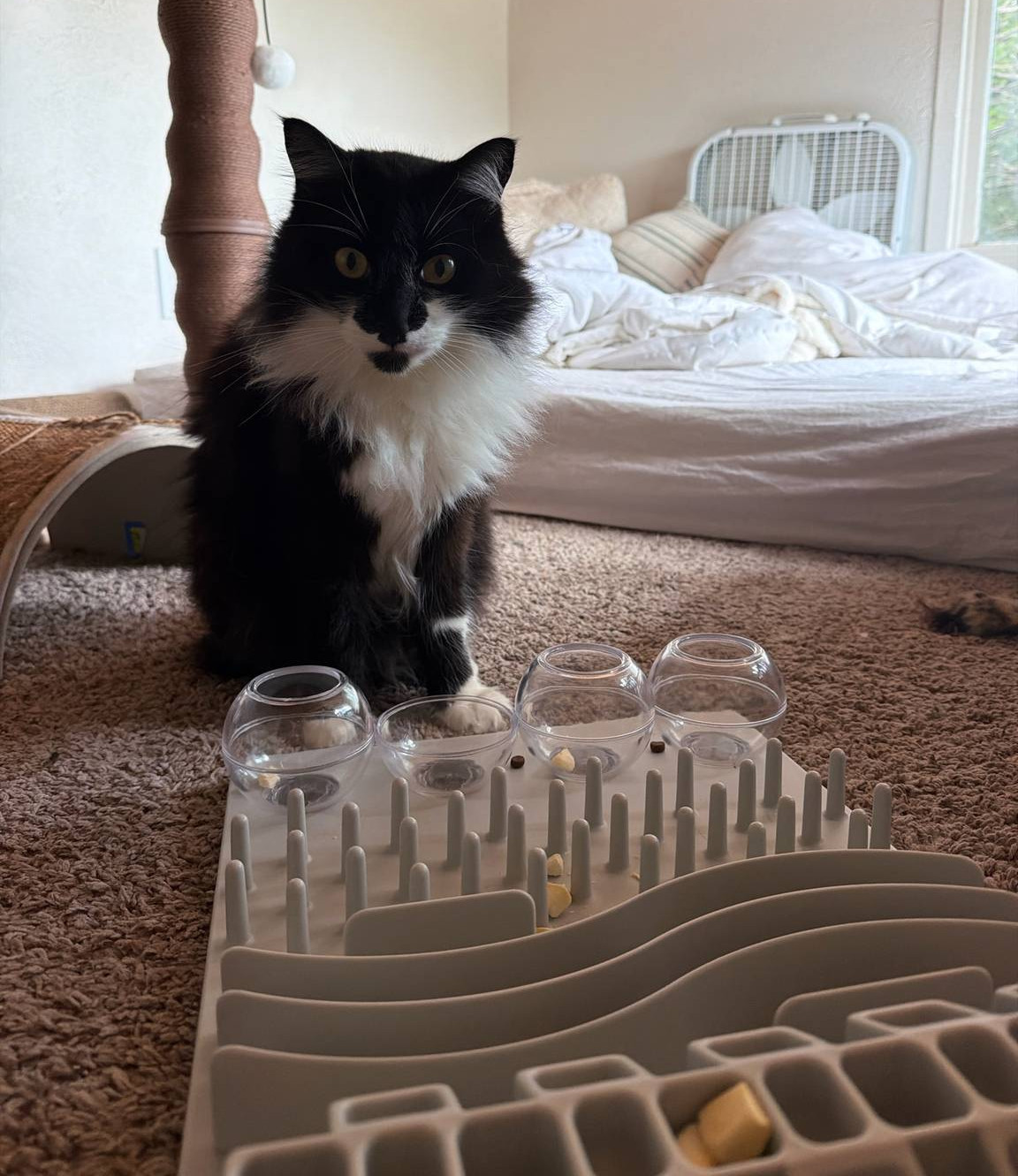
Food puzzles and puzzle boards are another great option. Instead of simply eating from a bowl, your cat has to paw, push, roll, or manipulate something to get the food. Just remember that treats and food used for games still count toward your cat's daily intake.
Think Vertically
Humans tend to look at a room in terms of floor space. Cats see an entirely different landscape.
A cat tree, sturdy window perch, shelf, or other elevated resting spot can dramatically increase the usable territory in your home. High places allow cats to observe what's happening while feeling secure and safely removed from the action below.

If you have more than one cat, providing several elevated spaces can be especially valuable. Rather than forcing everyone to compete for the penthouse suite on the one cat tree, give your cats choices in different parts of the home.
And remember that "cat furniture" doesn't necessarily have to come from the pet store. The back of a couch beside a window, a securely positioned piece of furniture, or a cleared shelf may become prime feline real estate.

Give Them a Room With a View
For an indoor cat, a good window can provide hours of entertainment.
Place a cat tree, bed, or secure perch near a window where your cat can watch birds, squirrels, people, falling leaves, snow, and the endlessly suspicious activities of the neighbors. Think of it as live television for cats—with a constantly changing cast.
Just make sure windows and screens are secure. An enticing bird on the other side of a loose screen can be more temptation than some cats can resist.
Provide Plenty of Places to Scratch
Scratching isn't bad behavior. It's normal cat behavior.
Cats scratch to stretch, maintain their claws, leave scent and visual marks, and communicate. Instead of trying to stop scratching altogether, give your cat appealing places where scratching is encouraged.
Offer a variety of scratching surfaces and orientations. Some cats prefer tall vertical posts where they can stretch to their full length, while others love horizontal cardboard scratchers. Sisal, cardboard, carpet, and wood may appeal to different cats.
Pay attention to where your cat already wants to scratch. A beautiful scratching post hidden in the spare bedroom isn't particularly helpful if your cat has decided the corner of the living-room sofa is the perfect location.

Create Cozy Retreats
Enrichment isn't always about activity. Cats also need places where they can feel safe and completely relax.
Provide beds, blankets, boxes, covered hideaways, and quiet resting places throughout your home. Some cats prefer curling up somewhere enclosed and private, while others want to sleep in the middle of everything where they can supervise the household.
Sunbeams deserve special consideration. If your cat has identified a particular patch of afternoon sunshine as the spot, placing a bed or blanket there may earn you significant approval.
Rotate the Toy Collection
A basket containing 27 cat toys isn't necessarily more exciting than three good ones.
Instead of leaving every toy out all the time, try rotating them. Put some away for a week or two and then bring them back. An old toy can suddenly become interesting again simply because it disappeared for a while.
Interactive toys such as wand toys are especially valuable because they let your cat stalk, chase, pounce, and capture "prey." Try moving the toy like something a cat might actually hunt—darting behind furniture, pausing, hiding, and occasionally allowing your cat to make the catch.
Always supervise toys with strings, ribbons, feathers, or small pieces that could be swallowed, and put unsafe interactive toys away when playtime is over.
Put Their Brain to Work
Mental exercise can be just as valuable as physical exercise.
Puzzle feeders, treat balls, activity boards, cardboard-box mazes, and simple homemade games encourage cats to solve problems and investigate their surroundings. You can even teach many cats simple behaviors using positive reinforcement, such as coming when called, touching a target, sitting, or giving a high five.
Keep sessions short and fun. The goal isn't obedience—it's giving your cat something interesting to think about.
Try a Little Cat TV
Yes, cat TV really is a thing.
Some cats are fascinated by videos of birds, squirrels, fish, insects, or other small animals. If your cat enjoys them, an occasional nature video can provide another source of visual and auditory stimulation, particularly on quiet days.
Just don't consider a screen a replacement for interactive play. Watching a digital bird may be entertaining, but stalking a wand toy with you provides movement, problem-solving, social interaction, and the satisfaction of actually catching something.
Also make sure the television or tablet is secure. Some enthusiastic viewers take their nature documentaries very seriously.

Don't Forget the Cardboard Box
You can spend a small fortune on enrichment equipment only to discover that your cat prefers the box it arrived in.
Embrace it.
Cardboard boxes, paper bags with the handles removed, packing paper, and simple tunnels can become inexpensive places to hide, stalk, pounce, investigate, and nap. Move them around occasionally or combine several boxes to create something new.
Sometimes the best enrichment really is free.
Create a Home That Changes
One of the easiest ways to prevent boredom is simply to make your cat's world a little less predictable.
Move a box to another room. Hide a few treats before leaving for work. Put out a toy your cat hasn't seen recently. Open the blinds on a favorite window. Introduce a new puzzle feeder. Spend ten minutes with a wand toy before dinner.
You don't need to do everything every day. In fact, novelty is part of what makes enrichment interesting.

The Happy Indoor Cat Checklist
✓ Places to climb — Cat trees, shelves, and sturdy elevated perches.
✓ Windows to watch — Give your cat a comfortable, secure spot with a view.
✓ Appropriate scratching surfaces — Offer different materials and both vertical and horizontal options.
✓ Cozy sleeping spots — Provide beds, boxes, blankets, and quiet retreats in several locations.
✓ Interactive play — Make time for chasing, stalking, pouncing, and catching.
✓ Rotating toys — Keep some toys out of sight and periodically swap them.
✓ Food enrichment — Try puzzle feeders, treat hunts, and activity boards.
✓ Opportunities to explore — Boxes, tunnels, paper, and changing environments can make familiar spaces interesting again.
✓ Mental challenges — Food puzzles and short training sessions exercise the brain.
✓ A little cat TV — Birds, squirrels, or fish on screen may entertain cats who enjoy watching them.
✓ Time with you — Enrichment doesn't replace companionship. Play, affection, grooming, and simply spending time together matter, too.
A Happy Cat Doesn't Need a Huge House
Creating an enriching indoor environment isn't about buying the fanciest cat tree or filling every room with toys. It's about looking at your home from your cat's perspective.
Can they climb? Scratch? Hide? Hunt? Explore? Watch the world outside? Choose between a quiet retreat and a perch near their favorite person?
Small changes can make a surprisingly big difference. Hide a few treats before you leave the house. Put a bed beside a favorite window. Rotate the toys. Bring home a cardboard box. Spend a few minutes letting your cat stalk a feather wand before dinner.
Your home may not seem particularly exciting to you—but with a little creativity, it can become a whole world for your cat to explore.
And if all else fails, put an empty cardboard box in the middle of the floor. Your cat will know what to do.

Comments